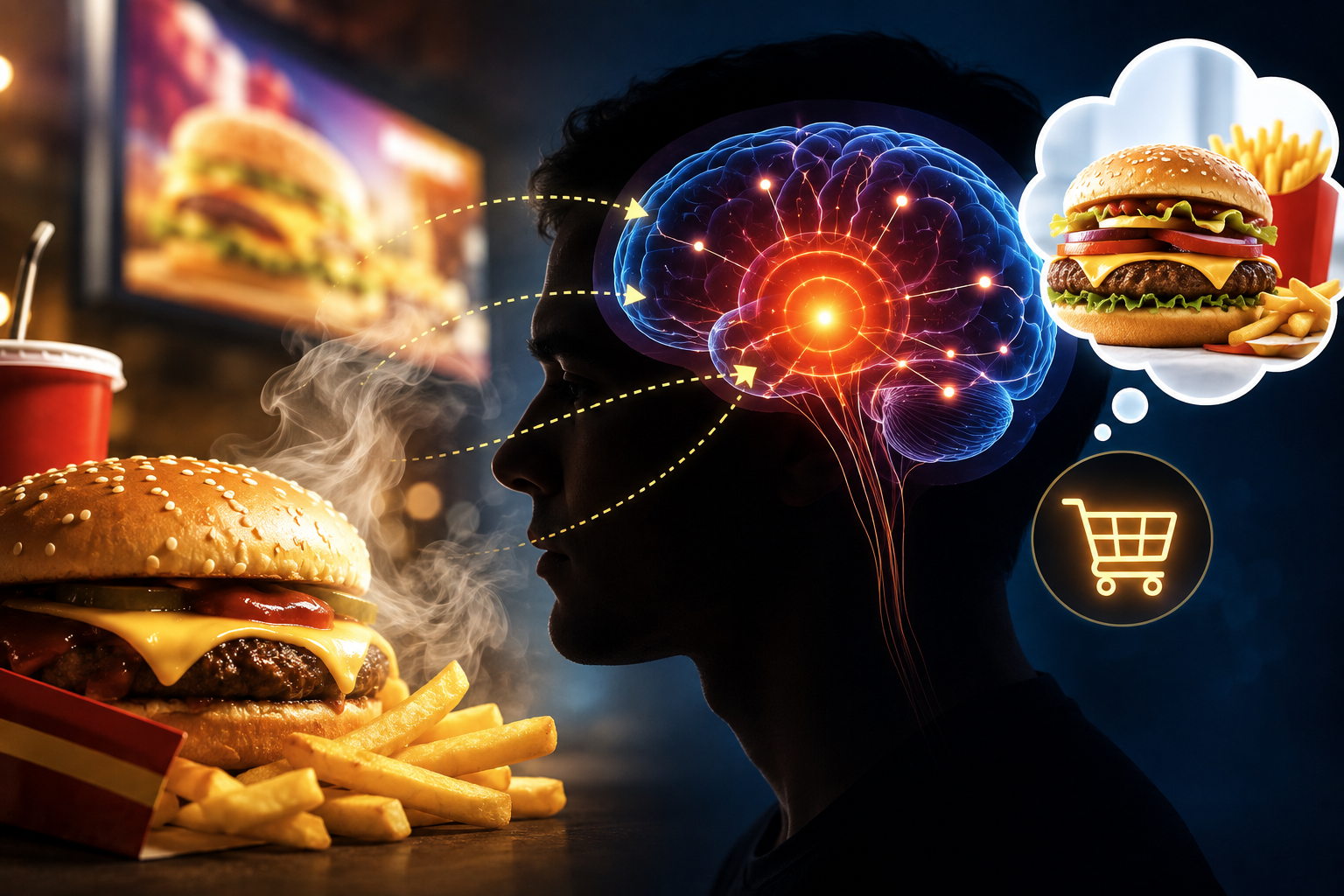
You may have just eaten and feel completely full. Then you walk past a burger outlet, smell French fries, see melted cheese dripping across a giant screen—and suddenly you want food again.
It can feel as if fast-food smells and visuals “hijack” your brain. That is not literally what happens, but research shows that food cues can trigger attention, learned associations, reward anticipation and cravings, sometimes increasing the desire to eat even when physical hunger is not the main driver.
The Smell Trigger: Why Food Aroma Can Create Cravings
Smell is a powerful food cue. Your brain learns to associate particular aromas with previous eating experiences.
For example, the smell of fried potatoes may repeatedly predict a familiar reward: hot, salty, energy-dense food. Over time, the aroma itself can become a conditioned cue, helping trigger appetite and the expectation of eating.
Research on olfactory and visual food cues has also examined the difference between “liking” food and “wanting” it. These are related but not identical. You may not be particularly hungry, yet still experience a strong desire to eat after encountering an appealing food cue.
Your current state matters too: food cues generally do not act in isolation. Hunger, previous experiences, habits and the surrounding environment can change how strongly a smell affects appetite.
The Visual Hijack: Your Eyes See Food Before Your Stomach Decides
Fast-food marketing is highly visual for a reason.
Close-up images emphasize features such as:
- Melted cheese
- Crispy textures
- Glossy sauces
- Steam
- Large portions
- Familiar logos and packaging
These cues make food highly noticeable and can trigger reward anticipation.
A systematic review and meta-analysis of experimental studies found that exposure to food advertising was associated with a small but statistically significant increase in food intake in both children and adults. The effect was larger in children.
A newer systematic review and meta-analysis likewise found that food marketing was associated with increased unhealthy food choice and increased consumption, although the evidence varied across settings and study designs.
Dopamine Is Not Simply a “Pleasure Chemical”
The popular explanation that fast food simply gives the brain a “dopamine hit” is too simplistic.
Dopamine is importantly involved in motivation, learning and reward prediction. When your brain repeatedly learns that a particular sight, smell or place predicts a rewarding food experience, that cue can acquire motivational power.
In simple terms:
See the logo → expect the food → anticipate the reward → feel a stronger urge to eat.
This helps explain why a familiar fast-food sign, smell or advertisement may trigger a craving before you have taken a single bite.
Why Smell + Sight + Convenience Can Be So Powerful
The real-world food environment often combines multiple cues at once:
Smell + food image + brand recognition + past memories + instant availability.
Imagine driving home tired. You see a familiar restaurant sign, smell food, remember enjoying it before and can order within seconds. Your brain is not responding to one isolated stimulus—it is processing an entire cue-rich environment.
That does not mean people lose control or that every craving leads to overeating. But repeated exposure can make eating more automatic and shift attention toward highly rewarding foods.
Can You Interrupt the Cue-Craving Cycle?
A useful first step is simply identifying the trigger. When a sudden craving appears, pause and ask:
“Am I physically hungry—or did something I saw, smelled or experienced trigger the urge?”
Other strategies include planning meals before becoming extremely hungry, reducing unnecessary food-delivery notifications and keeping convenient alternatives available.
Bottom Line
Fast-food smells and visuals do not literally hijack the brain. But scientific evidence shows that food cues and advertising can influence attention, reward anticipation, cravings and food intake. In an environment saturated with highly appealing food signals, understanding the difference between physical hunger and cue-triggered wanting may help make eating decisions more conscious.
Disclaimer: This article is for educational purposes and does not provide medical or psychological advice. Cravings and eating behaviour are influenced by many biological, psychological and environmental factors.