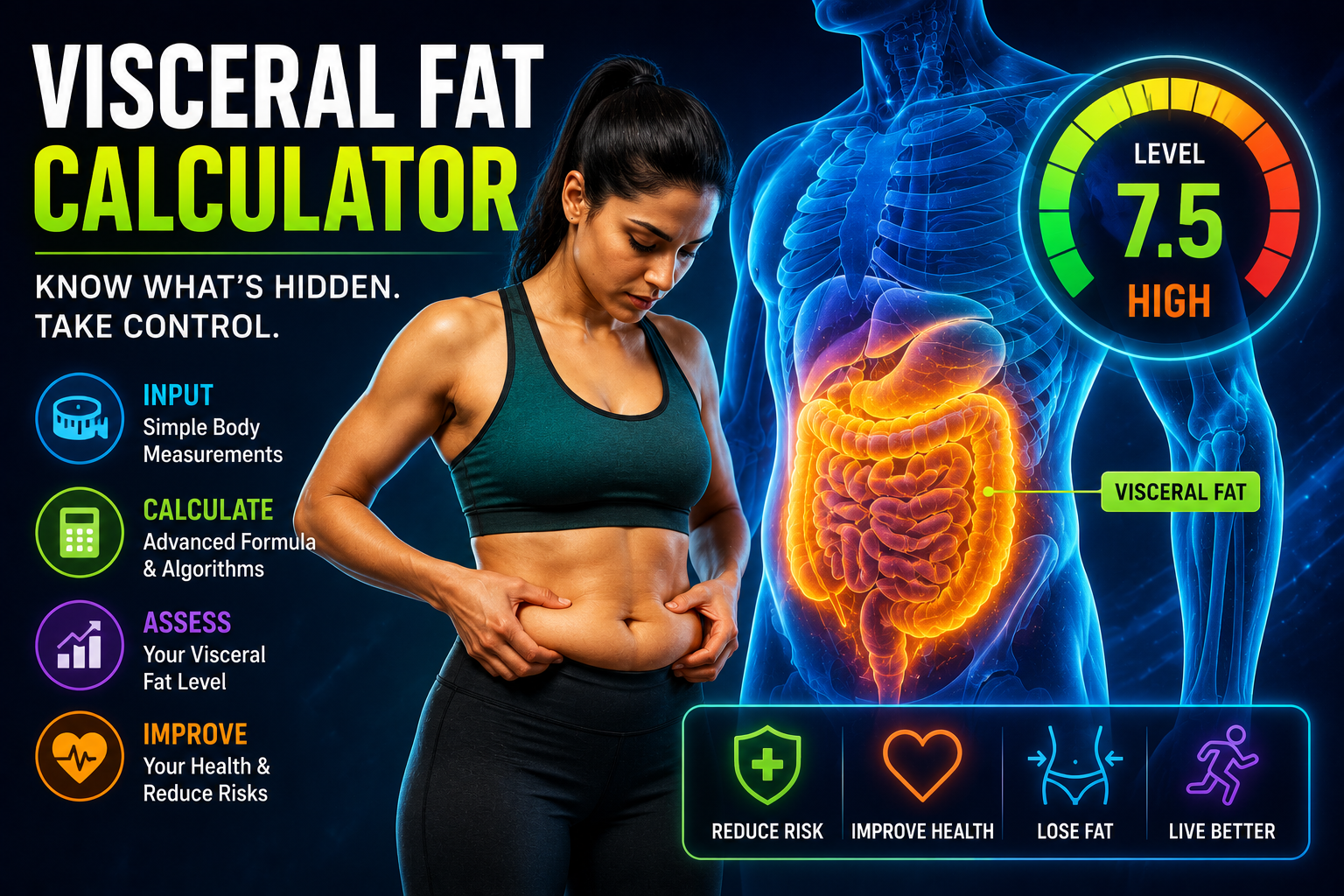
🧬 Visceral Fat Risk Calculator
Estimate your visceral fat level using waist, height, age, gender and thigh circumference
📊 Based on LIH validated anthropometric model Model: Luxembourg Institute of Health📋 Your Measurements & Risk Factors
Enter your measurements to see your results.
💡 What This Means
Your results will appear here with personalized guidance.
📌 References: Samouda H, Dutour A, Chaumoitre K, Panuel M, Dutour O, Dadoun F. VAT=TAAT-SAAT: innovative anthropometric model to predict visceral adipose tissue without resort to CT-Scan or DXA. Obesity (Silver Spring). 2013;21(1):E41-50.
What Is Visceral Fat and Why Does It Matter?
Visceral fat is the intra-abdominal adipose tissue stored around several organs, including the stomach, the intestines, and the liver. Unlike subcutaneous fat (the pinchable fat just under your skin), visceral fat is hidden deep inside your abdomen.
This “hidden fat” is metabolically active and produces inflammatory substances that can lead to serious health problems. An increase in visceral fat of more than 130 cm² defines Visceral Obesity — a major risk factor for several chronic diseases at any weight or BMI level.
Key Insight: Visceral fat depots can increase in people having normal weight, overweight, or obesity. You can be “skinny fat” with a normal BMI but dangerously high visceral fat.
Health Risks Associated with Visceral Obesity
Visceral Obesity is a major risk factor for developing:
| Condition | Risk Level |
|---|---|
| Type 2 diabetes | ⬆️⬆️⬆️ |
| Hypertension (high blood pressure) | ⬆️⬆️⬆️ |
| Heart attack | ⬆️⬆️⬆️ |
| Stroke | ⬆️⬆️⬆️ |
| Colon cancer | ⬆️⬆️ |
| Breast cancer | ⬆️⬆️ |
| Dementia | ⬆️⬆️ |
| Inflammatory diseases (Crohn’s, spondylitis) | ⬆️⬆️ |
These risks are independent of total fat mass. Even if you’re at a healthy weight, high visceral fat increases your risk.
Why BMI Isn’t Enough
Body Mass Index (BMI) has been the standard for decades, but it has significant limitations:
| What BMI Measures | What BMI Misses |
|---|---|
| Weight relative to height | Fat distribution |
| General corpulence | Visceral fat |
| — | Muscle mass |
| — | Bone density |
| — | Fat vs. muscle composition |
⚠️ Important: BMI gives only a general idea of corpulence. It does NOT give any indication of Visceral Fat — the major risk factor of several chronic diseases independently of total fat mass.
Example: Two people with the same BMI of 25 can have completely different health risks:
- Person A: Muscular athlete → Low visceral fat → Lower risk
- Person B: Sedentary with central obesity → High visceral fat → Higher risk
That’s why we need better tools — and why the Visceral Fat Calculator is so valuable.
Introducing the Visceral Fat Calculator
Our Visceral Fat Risk Calculator uses an anthropometric model validated by the Luxembourg Institute of Health (LIH) . It combines four simple measurements:
- Waist Circumference
- Proximal Thigh Circumference (NEW)
- Height
- Age & Gender
The Science Behind It
The calculator is based on the VAT = TAAT – SAAT formula developed by Samouda et al. (2013):
- VAT = Visceral Adipose Tissue (what we want to measure)
- TAAT = Total Abdominal Adipose Tissue
- SAAT = Subcutaneous Abdominal Adipose Tissue
While we can’t directly measure SAAT without imaging, thigh circumference serves as a validated proxy for subcutaneous fat distribution. This makes the LIH model one of the most accurate non-imaging predictors of visceral fat.
Why We Added Proximal Thigh Circumference
The Thigh-Visceral Fat Connection
Recent research has revealed a protective relationship between thigh circumference and visceral fat:
- Larger thighs = More subcutaneous fat storage capacity
- Smaller thighs = Less place to store fat safely → More fat stored around organs
Think of it like this: Your thighs are like a “safe storage warehouse” for fat. When this warehouse is small, fat gets redirected to the dangerous “VIP section” around your organs (visceral fat).
What the Research Shows
| Study Finding | Implication |
|---|---|
| Thigh circumference is inversely associated with cardiovascular disease risk | Larger thighs = lower risk |
| Thigh-to-height ratio is a predictor of metabolic syndrome | Lower ratio = higher risk |
| Waist-to-thigh ratio predicts diabetes risk | Higher ratio = higher risk |
💡 Takeaway: People with smaller thighs relative to their height are at higher risk for visceral fat accumulation, even if their waist is normal.
How to Accurately Measure Your Thigh
Getting an accurate thigh measurement is crucial for the calculator to work properly. Follow these steps:
Equipment Needed
- Flexible measuring tape (fabric or plastic)
- A mirror (optional, for checking placement)
Step-by-Step Guide
- Stand up straight with your feet hip-width apart.
- Locate the correct position: Measure at the widest point of the upper thigh, just below the gluteal fold (where your buttock meets your thigh).
- Wrap the tape around your thigh horizontally.
- Keep it snug but not compressing the skin.
- Read the measurement at the point where the tape overlaps.
✅ Pro Tip: Take the measurement in the morning before eating or exercising for consistency.
Common Mistakes to Avoid
❌ Measuring too high (on the gluteal fold itself)
❌ Measuring too low (mid-thigh)
❌ Pulling the tape too tight
❌ Measuring over clothing
Understanding Your Visceral Fat Risk Score
The calculator provides a score from 0 to 10 , with clear risk categories:
Score Interpretation
| Score Range | Risk Level | What It Means |
|---|---|---|
| 0 – 3.0 | 🟢 Low Risk | Healthy fat distribution. Continue healthy habits. |
| 3.1 – 5.5 | 🟡 Moderate Risk | Some visceral fat accumulation. Consider lifestyle improvements. |
| 5.6 – 8.0 | 🟠 High Risk | Elevated visceral fat. Increased metabolic risk. |
| 8.1 – 10.0 | 🔴 Very High Risk | Significantly elevated visceral fat. See a doctor. |
What the Score Looks At
The calculator combines five components:
- Waist Circumference (35% weight) — The primary visceral fat indicator
- Waist-to-Height Ratio (25% weight) — Adjusts for body size
- Thigh Ratio (20% weight) — Subcutaneous fat indicator
- Waist-to-Thigh Ratio (15% weight) — Fat distribution pattern
- Age (5% weight) — Visceral fat tends to increase with age
Visceral Fat vs. Subcutaneous Fat: What’s the Difference?
| Feature | Subcutaneous Fat | Visceral Fat |
|---|---|---|
| Location | Under the skin | Around organs (liver, intestines, heart) |
| Pinchable? | ✅ Yes | ❌ No |
| Health Risk | Low | High |
| Metabolic Activity | Low | High (produces inflammatory markers) |
| How to Lose | Diet + Exercise | Diet + Exercise (but responds better to exercise) |
| Measurement | Calipers, tape measure | CT/MRI, DEXA, or validated models |
🔬 Science Says: Visceral fat is the most dangerous type of fat because it releases inflammatory substances and free fatty acids directly into the liver and portal circulation.
How to Reduce Visceral Fat Naturally
If your score indicates elevated visceral fat, don’t panic. Visceral fat responds well to lifestyle changes.
1. Exercise (The Most Effective Tool)
| Type | Recommendation | Why It Works |
|---|---|---|
| Aerobic Exercise | 30+ minutes, 5-7 days/week | Brisk walking, cycling, swimming, jogging |
| HIIT | 2-3 sessions/week | Sprint workouts, squat jumps (supervised) |
| Strength Training | 2-3 sessions/week | Builds muscle, increases metabolism |
Key Insight: Visceral fat is more responsive to exercise than subcutaneous fat. In fact, exercise can reduce visceral fat even without weight loss.
2. Nutrition
✅ Increase:
- Fiber-rich foods (vegetables, fruits, legumes, whole grains)
- Lean protein (fish, chicken, tofu)
- Healthy fats (olive oil, avocados, nuts)
❌ Reduce:
- Refined carbohydrates (white bread, pasta, sugary drinks)
- Added sugars and sweeteners
- Trans fats and highly processed foods
3. Sleep and Stress Management
- Sleep: 7-8 hours per night (poor sleep increases cortisol → more visceral fat)
- Stress: Practice mindfulness, meditation, or yoga
4. Consistency Matters
The key is sustainable changes. Don’t try to do everything at once:
- Week 1-2: Add a 10-minute walk after meals
- Week 3-4: Add one fiber-rich food to each meal
- Week 5-6: Increase exercise to 30 minutes, 5 days/week
When to See a Doctor
🚩 Seek professional help if you experience:
- ✅ Score above 7.0 on the calculator
- ✅ Blood in your stool
- ✅ Black or tar-like stool
- ✅ Unexplained weight loss
- ✅ Severe or persistent abdominal pain
- ✅ Persistent vomiting
- ✅ Persistent or severe diarrhea
- ✅ A significant new change in bowel habits
⚠️ Important: The Visceral Fat Calculator is an educational tool, not a medical diagnostic test. It cannot replace professional medical advice.
Frequently Asked Questions
How accurate is the Visceral Fat Calculator?
The calculator is based on the LIH model, which has been validated against CT-scan measurements in peer-reviewed research. It is considered one of the most accurate non-imaging predictors of visceral fat.
Can I use the calculator if I’m pregnant?
No. The calculator is not validated for use during pregnancy. Please consult your healthcare provider.
How often should I re-take the calculator?
We recommend re-taking the calculator every 4-8 weeks if you’re making lifestyle changes. This allows enough time to see meaningful changes.
Is visceral fat the same as belly fat?
Not exactly. “Belly fat” includes both subcutaneous fat (which you can pinch) and visceral fat (which is deeper). Visceral fat is the more dangerous component.
What’s a healthy waist-to-thigh ratio?
Generally:
- Men: < 1.6 (lower is better)
- Women: < 1.4 (lower is better)
Can I lose visceral fat without losing weight?
Yes! Visceral fat is more responsive to exercise than other types of fat. You can reduce visceral fat even if the scale doesn’t change.
What is the VAT=TAAT-SAAT model?
This is the formula developed by Samouda et al. at the Luxembourg Institute of Health. It predicts visceral adipose tissue by estimating the difference between total abdominal fat and subcutaneous abdominal fat.
Ready to Check Your Visceral Fat Risk?
Use our free Visceral Fat Calculator now. It takes just 2 minutes and requires only a measuring tape.
Take the Visceral Fat Calculator