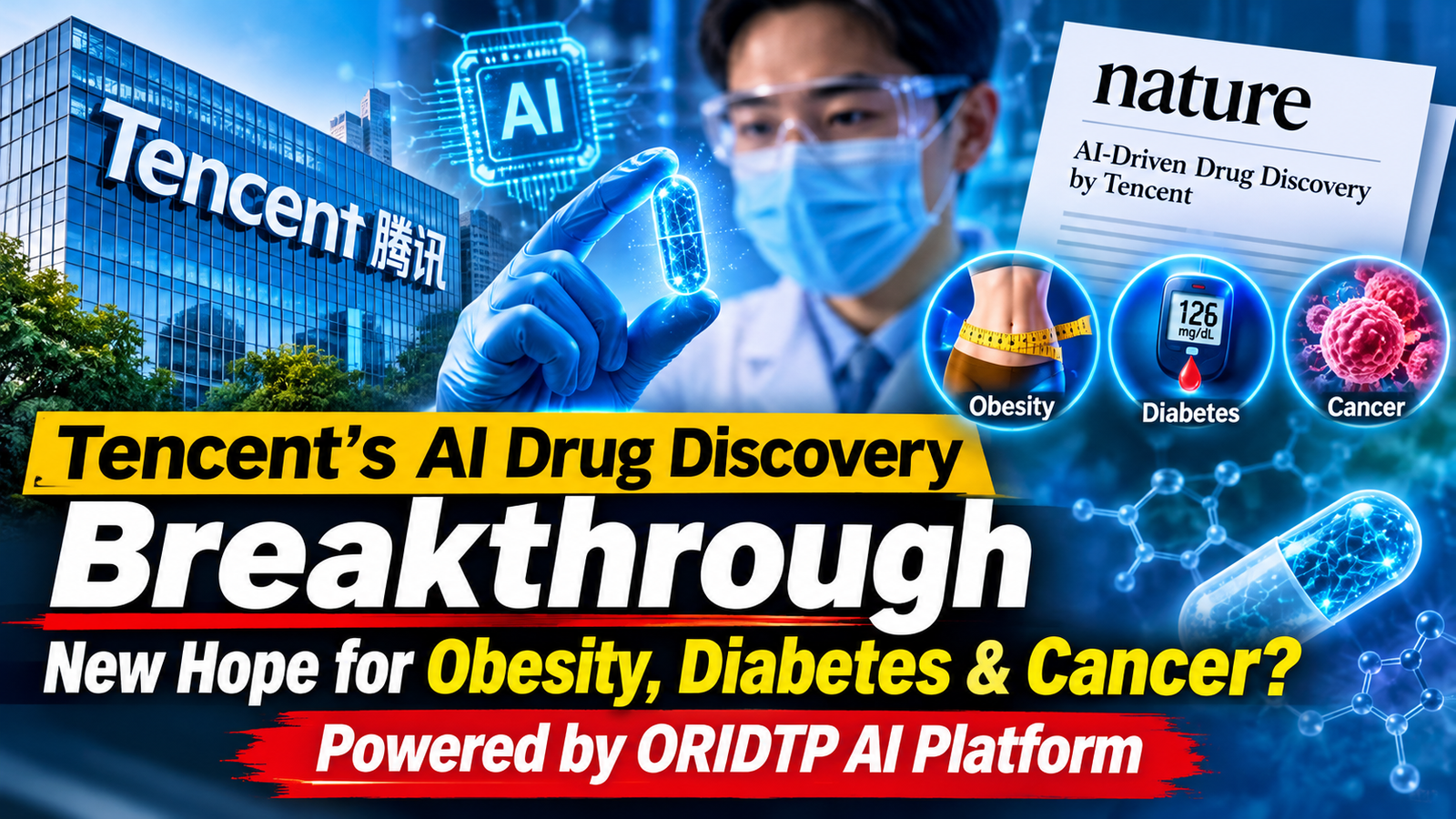
Artificial intelligence is steadily moving beyond chatbots and automation into scientific research. One of its most promising applications is drug discovery, where AI could help researchers identify and develop potential treatments more efficiently. China’s Tencent has taken a significant step in this direction with the development of ORIDTP, an AI-powered platform featured in the prestigious scientific journal Nature on November 25, 2026.
The research explores how AI can design therapeutic peptides capable of targeting two biological mechanisms simultaneously, potentially opening new possibilities for treating complex diseases.
How Tencent’s ORIDTP Platform Works
Developed by researchers from Tencent’s AI for Life Sciences Lab and collaborating institutions, ORIDTP focuses on designing dual-target therapeutic peptides.
Peptides are short chains of amino acids that can interact with specific biological targets in the human body. Traditionally, identifying promising drug candidates involves extensive laboratory screening. ORIDTP uses AI-driven design and optimisation to generate and refine potential candidates before experimental testing.
The platform was developed to address a major challenge in drug discovery: designing a single molecule that can effectively interact with two different therapeutic targets.
Promising Results in Obesity and Diabetes Research
One of the study’s major findings concerns metabolic diseases, particularly obesity and diabetes.
Researchers designed peptides targeting two receptors: GLP-1R and the glucagon receptor (GCGR). These receptors play important roles in regulating appetite, body weight and glucose metabolism.
In experiments involving obese and diabetic mice, the AI-designed peptide GA-Dual.R5.S3 demonstrated significant weight-loss and blood-sugar improvements.
Importantly, researchers also reported no nausea or aversion-related responses in the tested animal models. However, these findings do not establish safety or effectiveness in humans.
AI-Designed Peptides Show Potential Against Cancer
The research also explored applications in cancer immunotherapy.
Researchers designed peptides targeting two immune checkpoints, PD-1 and CTLA-4, which regulate immune system activity.
One experimental candidate, IC-Dual.P3, demonstrated a substantial reduction in tumour volume, achieving a 94.2% decrease compared with the control group in a preclinical mouse model.
Although encouraging, this result should not be interpreted as evidence of a successful cancer treatment in humans.
What This Breakthrough Means for AI in Healthcare
Tencent’s research highlights how AI could change the early stages of pharmaceutical development. Instead of relying exclusively on large-scale molecular screening, researchers can use computational models to generate targeted candidates and evaluate them through laboratory experiments.
Nevertheless, important challenges remain. ORIDTP’s findings are currently based on laboratory and animal studies. Human clinical trials will be necessary to establish safety, dosage, effectiveness and potential side effects.
Conclusion
Tencent’s ORIDTP research represents an important development in AI-assisted drug discovery. By demonstrating the potential to design dual-target peptides for metabolic diseases and cancer research, the platform offers a new direction for pharmaceutical innovation.
The real test, however, lies ahead: whether these promising experimental findings can translate into safe and effective treatments for people.
Reference: SCMP