If you are searching for a BMI chart for women, the first thing to know is that adult BMI categories are generally not different for women and men. BMI is calculated from height and weight, and standard adult categories are based on the same numerical cutoffs.
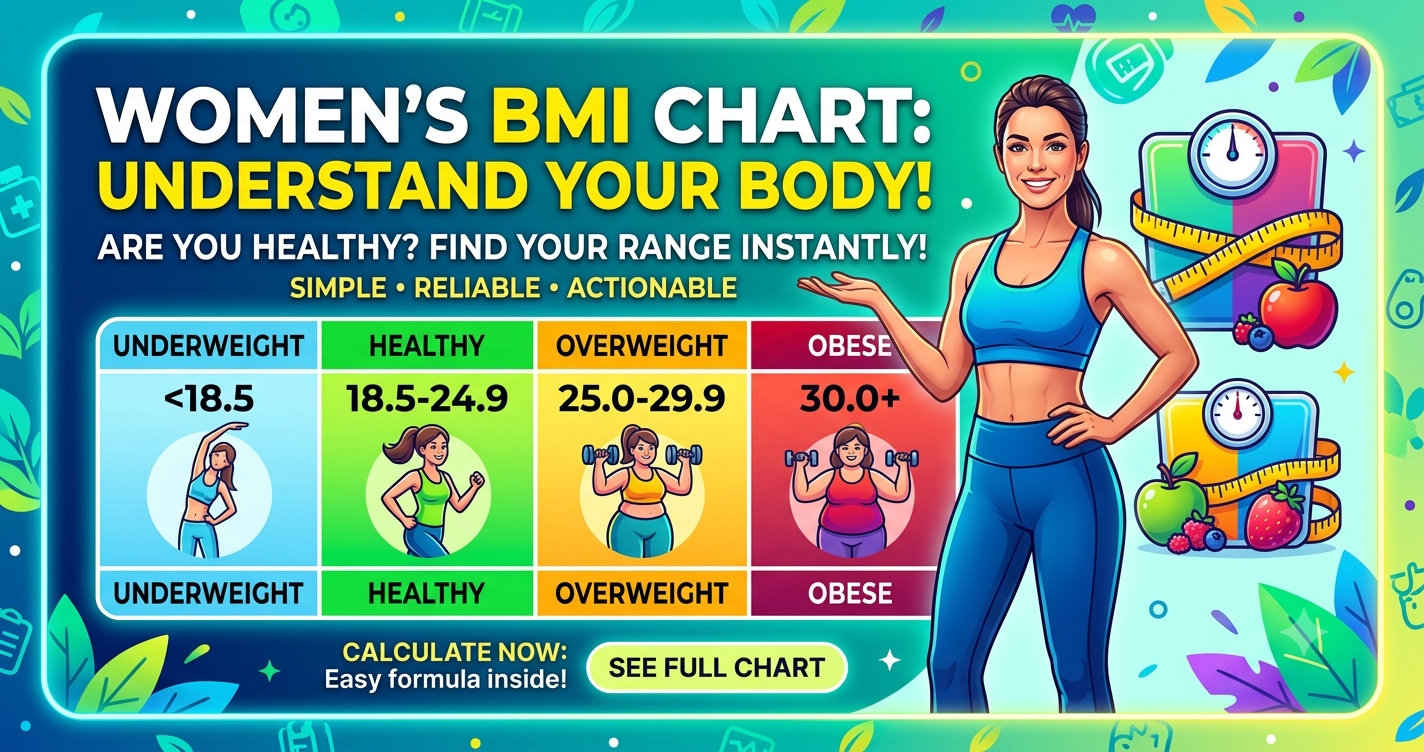
For adults, a BMI below 18.5 is classified as underweight, 18.5 to below 25 as healthy weight, 25 to below 30 as overweight, and 30 or higher as obesity. Obesity is further divided into Class 1, Class 2 and Class 3.
However, BMI is only a screening measure. It does not directly measure body fat, muscle mass, waist size or where fat is stored.
BMI Chart for Women
| BMI | Weight category |
|---|---|
| Below 18.5 | Underweight |
| 18.5–24.9 | Healthy weight |
| 25.0–29.9 | Overweight |
| 30.0–34.9 | Class 1 obesity |
| 35.0–39.9 | Class 2 obesity |
| 40.0 or higher | Class 3 obesity |
These are the standard adult categories used by the CDC.
What is a healthy BMI for women?
For an adult woman, a BMI of 18.5 to 24.9 is generally considered the healthy-weight range under the standard international classification.
But there is no single BMI that is automatically “perfect” for every woman. Two women with the same BMI can have different amounts of muscle, body fat and abdominal fat.
The World Health Organization also notes that BMI values are age-independent for adults and use the same basic categories for women and men, although the relationship between BMI and body fat can vary among populations.
BMI Chart for Women by Height and Weight
One of the most common searches is “What is the healthy weight for my height?”
The table below converts the standard BMI boundaries into approximate weight ranges.
| Height | Healthy weight BMI 18.5–24.9 | Overweight BMI 25–29.9 | Obesity BMI 30+ |
|---|---|---|---|
| 4’10” (147 cm) | 89–119 lb / 40–54 kg | 120–143 lb / 54–65 kg | 144+ lb / 65+ kg |
| 4’11” (150 cm) | 92–123 lb / 42–56 kg | 124–148 lb / 56–67 kg | 149+ lb / 68+ kg |
| 5’0″ (152 cm) | 95–127 lb / 43–58 kg | 128–153 lb / 58–69 kg | 154+ lb / 70+ kg |
| 5’1″ (155 cm) | 98–132 lb / 44–60 kg | 133–158 lb / 60–72 kg | 159+ lb / 72+ kg |
| 5’2″ (157 cm) | 101–136 lb / 46–62 kg | 137–163 lb / 62–74 kg | 164+ lb / 74+ kg |
| 5’3″ (160 cm) | 104–140 lb / 47–64 kg | 141–169 lb / 64–77 kg | 170+ lb / 77+ kg |
| 5’4″ (163 cm) | 108–145 lb / 49–66 kg | 146–173 lb / 66–79 kg | 174+ lb / 79+ kg |
| 5’5″ (165 cm) | 111–149 lb / 50–68 kg | 150–179 lb / 68–81 kg | 180+ lb / 82+ kg |
| 5’6″ (168 cm) | 115–154 lb / 52–70 kg | 155–185 lb / 70–84 kg | 186+ lb / 84+ kg |
| 5’7″ (170 cm) | 118–159 lb / 54–72 kg | 160–190 lb / 73–86 kg | 191+ lb / 87+ kg |
| 5’8″ (173 cm) | 122–164 lb / 55–74 kg | 165–196 lb / 75–89 kg | 197+ lb / 89+ kg |
| 5’9″ (175 cm) | 125–168 lb / 57–76 kg | 169–202 lb / 77–92 kg | 203+ lb / 92+ kg |
| 5’10” (178 cm) | 129–173 lb / 59–78 kg | 174–208 lb / 79–94 kg | 209+ lb / 95+ kg |
| 5’11” (180 cm) | 133–178 lb / 60–81 kg | 179–214 lb / 81–97 kg | 215+ lb / 98+ kg |
| 6’0″ (183 cm) | 136–183 lb / 62–83 kg | 184–220 lb / 83–100 kg | 221+ lb / 100+ kg |
The figures are calculated from the standard BMI formula and rounded, so individual charts may differ slightly because of rounding. The American Heart Association provides a similar height-based adult weight table.
BMI Formula for Women
BMI is calculated using weight and height.
Metric formula
BMI = weight in kilograms ÷ height in metres²
For example:
A woman weighs 70 kg and is 1.65 m tall.
BMI:
70 ÷ (1.65 × 1.65) = 25.7
A BMI of 25.7 falls into the standard overweight category.
Imperial formula
If you use pounds and inches:
BMI = weight in pounds ÷ height in inches² × 703
The CDC uses these formulas for adult BMI calculations.
BMI Chart for Women by Age
Another extremely common search is:
“What is the normal BMI for women by age?”
The important answer is that the standard adult BMI category does not change simply because a woman gets older.
For adults, the standard categories remain:
- Under 18.5 — underweight
- 18.5–24.9 — healthy weight
- 25–29.9 — overweight
- 30+ — obesity
The CDC states that for adults 20 and older, BMI categories are based on BMI regardless of age or sex.
Women aged 18–19
Young adults are a special transition group. Different health systems use different age boundaries for adult BMI tools. The NHS adult calculator applies to people aged 18 and over, while the CDC adult calculator is designed for adults 20 and older.
Women in their 20s and 30s
The standard adult BMI categories apply.
However, BMI does not show whether weight comes predominantly from muscle, fat, bone or other tissue.
Women in their 40s and 50s
During perimenopause and menopause, changes in body composition and fat distribution can make BMI less informative on its own.
A woman may maintain a similar body weight while experiencing changes in muscle mass and abdominal fat.
Therefore, BMI should ideally be considered alongside waist circumference, blood pressure, blood glucose, lipids, physical activity and overall medical history.
Women aged 60 and older
BMI remains a useful screening measure, but changes in muscle mass become increasingly important.
An older woman can have a BMI within the standard range while carrying relatively more body fat and less muscle than the number suggests.
Therefore, BMI should not be interpreted in isolation in older adults.
BMI Chart for Women Over 50
There is no separate official BMI scale that suddenly starts at age 50.
The standard adult categories remain the same.
| BMI | Standard category |
|---|---|
| <18.5 | Underweight |
| 18.5–24.9 | Healthy weight |
| 25–29.9 | Overweight |
| 30–34.9 | Class 1 obesity |
| 35–39.9 | Class 2 obesity |
| ≥40 | Class 3 obesity |
But after menopause, where body fat is stored can become particularly relevant. This is one reason a waist measurement can add information that BMI cannot provide.
BMI and Waist Circumference for Women
BMI tells you about the relationship between height and weight. It does not tell you how much abdominal fat you carry.
That matters because excess abdominal fat is associated with cardiometabolic risk.
The CDC says women with a waist circumference greater than 35 inches (88 cm) are at higher risk for health problems related to excess abdominal fat.
A waist measurement should therefore be considered alongside BMI rather than as a replacement for it.
How to measure your waist
Stand upright and place the measuring tape around your abdomen, just above your hip bones. Breathe out normally and take the measurement after exhaling.
BMI for Asian Women
This is particularly important for women of Asian ancestry.
Some Asian populations can develop metabolic conditions such as type 2 diabetes at lower BMI levels than the standard international thresholds suggest.
The WHO expert consultation identified 23.0 and 27.5 kg/m² as additional public-health action points for Asian populations, while retaining the standard international BMI classification.
The NHS currently uses lower thresholds when assessing health risk for people from Asian, Chinese, Middle Eastern, Black African and African-Caribbean backgrounds: BMI 23–27.4 is classified as overweight and 27.5 or higher as obese in its ethnicity-adjusted adult guidance.
This is an important reason why a BMI calculator intended for a global audience should ask about ethnic background or country/clinical guideline before automatically interpreting the result.
Is BMI Different for Women and Men?
For standard adult BMI classification, the numerical BMI cutoffs are the same.
A BMI of 27 means the same mathematical BMI whether the person is male or female.
However, BMI does not capture differences in:
- body-fat percentage
- muscle mass
- fat distribution
- hormonal status
- pregnancy
- menopause
- ethnicity
- age-related muscle loss
Therefore, the same BMI does not necessarily mean exactly the same health profile for two individuals.
What Is the Ideal Weight for a Woman?
There is no single scientifically determined “ideal weight” for every woman.
A better question is:
“What weight corresponds to a healthy BMI for my height?”
For example, using the standard BMI range:
- A 5’0″ woman has a healthy-weight range of roughly 95–127 lb.
- A 5’4″ woman has a healthy-weight range of roughly 108–145 lb.
- A 5’8″ woman has a healthy-weight range of roughly 122–164 lb.
These are screening ranges, not personal prescriptions.
Your appropriate weight may also depend on muscle mass, waist circumference, medical conditions, medications, fitness and nutritional status.
Is a BMI of 18.5 Healthy for Women?
A BMI of 18.5 is at the lower boundary of the standard healthy category.
A BMI below 18.5 is classified as underweight.
Being underweight can sometimes be associated with inadequate nutrition or underlying health problems, particularly if weight loss is sudden or unexplained.
If you have unintentionally lost weight, it is more important to investigate the reason than simply trying to reach a particular BMI number.
Is a BMI of 25 Overweight for Women?
Under standard adult BMI classifications, yes.
A BMI of 25.0 is the beginning of the overweight category.
The standard categories are:
18.5–24.9: healthy weight
25.0–29.9: overweight
30.0+: obesity
However, BMI is a screening tool and does not diagnose a disease.
What Does a BMI of 30 Mean for a Woman?
A BMI of 30 or above falls into the obesity category under standard adult criteria.
The CDC divides obesity into:
- Class 1: BMI 30–34.9
- Class 2: BMI 35–39.9
- Class 3: BMI 40 or higher
Class 3 is also described by the CDC as severe obesity.
A higher BMI is associated with increased risk for conditions including type 2 diabetes, high blood pressure and abnormal cholesterol, but BMI alone cannot determine whether an individual has any of these conditions.
BMI During Pregnancy
A standard BMI calculator should not be used to judge weight status during pregnancy in the same way as it is used for a non-pregnant adult.
Pregnancy involves expected changes in:
- fetus weight
- placenta
- amniotic fluid
- blood volume
- breast tissue
- maternal fat stores
For pregnancy, healthcare professionals use pre-pregnancy BMI to help determine appropriate weight-gain targets.
For a singleton pregnancy, CDC recommendations include:
| Pre-pregnancy BMI | Recommended total weight gain |
|---|---|
| <18.5 | 28–40 lb |
| 18.5–24.9 | 25–35 lb |
| 25–29.9 | 15–25 lb |
| 30–39.9 | 11–20 lb |
These recommendations are for a pregnancy with one baby. Twin pregnancies have different targets.
BMI After Pregnancy
Postpartum weight should also be interpreted carefully.
A woman’s weight can change because of:
- pregnancy-related fluid changes
- breastfeeding
- reduced activity
- sleep disruption
- hormonal changes
- changes in appetite
- muscle loss or gain
Instead of focusing exclusively on reaching a particular BMI immediately, postpartum weight management should consider recovery, nutrition, breastfeeding where applicable, physical activity and medical advice.
BMI Does Not Measure Body Fat Directly
This is one of the biggest limitations of BMI.
Two women can have exactly the same BMI but very different body compositions.
BMI does not directly measure:
- body-fat percentage
- visceral fat
- muscle mass
- bone density
- waist circumference
- fat distribution
For example, a woman with substantial muscle mass could have a higher BMI without having excessive body fat.
The NHS specifically notes that BMI cannot distinguish between muscle and fat.
BMI vs Body Fat Percentage
BMI answers:
“How does my weight relate to my height?”
Body-fat percentage attempts to answer:
“What proportion of my body weight is fat?”
Both have limitations.
Body-fat measurements can vary depending on the method used, including:
- bioelectrical impedance
- skinfold measurements
- DEXA
- air displacement
- other clinical techniques
A body-fat percentage should therefore also be interpreted within the context of the measurement method.
BMI vs Waist Circumference
These measurements provide different information.
BMI
Useful for assessing weight relative to height.
Waist circumference
Provides information about abdominal fat.
Together
BMI + waist circumference can provide a more useful picture than either measurement alone.
The CDC specifically recommends considering BMI alongside waist circumference when assessing healthy weight.
BMI for Women With High Muscle Mass
A muscular woman can have a BMI above 25 without having excessive body fat.
This is because BMI counts total body mass and does not distinguish muscle from fat.
Therefore, athletes and highly muscular individuals should not interpret BMI in isolation.
When BMI May Be Less Useful
BMI requires additional context for:
- pregnant women
- women with eating disorders
- highly muscular women
- women with significant edema or fluid retention
- some older adults with substantial muscle loss
- people with conditions affecting height
- children and teenagers
The NHS specifically advises against using its adult BMI calculator during pregnancy and in people with an eating disorder or conditions affecting height.
BMI for Girls and Teenagers Is Different
A major mistake is using an adult BMI chart for women for children.
For people aged 2–19, BMI is interpreted according to age and sex percentiles, rather than simply applying the adult 18.5–24.9 healthy range.
Therefore:
Adult woman → adult BMI categories
Girl/teenager → BMI-for-age percentile
The CDC uses a separate BMI-for-age system for children and teenagers.
How Accurate Is a BMI Calculator?
The mathematical calculation itself is straightforward.
The limitation is interpretation.
If height and weight are entered correctly, the calculator can accurately calculate BMI. But the BMI number cannot tell you your complete health status.
A more complete assessment may include:
- waist circumference
- blood pressure
- fasting glucose or HbA1c
- cholesterol
- physical activity
- dietary pattern
- sleep
- medications
- family history
- medical conditions
- body composition
The CDC describes BMI as a screening measure rather than a diagnostic test.
What Should Women Do With Their BMI Result?
BMI below 18.5
If you are underweight, consider whether the weight is intentional and stable.
Unexpected weight loss deserves medical attention.
BMI 18.5–24.9
This is the standard healthy-weight category.
Continue focusing on nutrition, physical activity, sleep and other health indicators rather than trying to reach the lowest possible BMI.
BMI 25–29.9
This is the standard overweight category.
Consider BMI together with waist circumference and metabolic health rather than treating the BMI number as a diagnosis.
BMI 30 or higher
This falls into the standard obesity category.
Depending on individual health factors, a healthcare professional may discuss nutrition, physical activity, behavioral treatment, anti-obesity medication or other treatment options.
BMI and Weight Loss Treatment
For women considering medical weight-management treatment, BMI can be one factor clinicians use when evaluating whether treatment may be appropriate.
However, BMI alone should not determine whether someone should take a GLP-1 or another anti-obesity medication.
A clinician may also consider:
- existing medical conditions
- blood pressure
- glucose status
- cholesterol
- previous weight-management attempts
- medications
- pregnancy status
- eating-disorder history
- contraindications
- treatment goals
This is particularly important because weight-loss medications are medical treatments, not simply tools for reaching a particular BMI number.
Frequently Asked Questions About BMI Chart for Women
What is a good BMI for a woman?
For most adults using standard international categories, 18.5–24.9 is classified as healthy weight. BMI should still be interpreted with other health measurements.
What is the normal BMI for a woman by age?
The standard adult healthy BMI range does not change simply because a woman ages: 18.5–24.9 remains the standard range. However, body composition and health risks can change with age.
What is the ideal weight for a 5’4″ woman?
Using the standard BMI healthy range, approximately 108–145 lb (49–66 kg) corresponds to BMI 18.5–24.9.
What is the ideal weight for a 5’5″ woman?
Approximately 111–149 lb (50–68 kg) corresponds to BMI 18.5–24.9.
What is the ideal weight for a 5’6″ woman?
Approximately 115–154 lb (52–70 kg) corresponds to BMI 18.5–24.9.
What is the ideal weight for a 5’7″ woman?
Approximately 118–159 lb (54–72 kg) corresponds to BMI 18.5–24.9.
Is BMI different for women?
The mathematical BMI formula and standard adult BMI category cutoffs are generally the same for women and men. The health interpretation, however, can require additional information about body composition, age, ethnicity and other factors.
Is BMI 25 overweight for women?
Yes. Under standard adult classifications, BMI 25.0–29.9 is overweight.
Is BMI 30 obese for women?
Yes. A BMI of 30 or higher falls into the obesity category under standard adult criteria.
Is BMI 35 dangerous?
BMI 35 falls into Class 2 obesity under standard adult categories. It indicates a higher level of excess weight, but BMI alone cannot determine an individual’s immediate health risk.
Does menopause change the BMI chart?
No. Menopause does not create a new official adult BMI cutoff. However, menopause can change body composition and fat distribution, so BMI may need to be interpreted alongside waist circumference and other health measures.
Does pregnancy change BMI?
Pregnancy changes how weight should be assessed. Pre-pregnancy BMI is used to determine recommended pregnancy weight gain rather than applying a standard adult BMI chart to the pregnancy weight itself.
The Bottom Line
A BMI chart for women is useful as a starting point, but it should not be treated as a definition of a woman’s health.
For most adults, the standard categories are:
Underweight: below 18.5
Healthy weight: 18.5–24.9
Overweight: 25–29.9
Obesity: 30 or higher
The most useful approach is to combine BMI with waist circumference, body composition, metabolic health, lifestyle and medical history.
For women who are pregnant, highly muscular, very young, older with significant muscle loss, or from populations where lower BMI thresholds may be clinically relevant, additional context is especially important.
Use BMI as a screening tool—not as a verdict on your body or your health.
Medical disclaimer
This article is for educational purposes and is not a substitute for individualized medical advice. BMI is a screening measure and does not diagnose obesity, disease or overall health. Pregnancy, eating disorders, medical conditions, medications, ethnicity, age and body composition can affect how BMI should be interpreted. Speak with a qualified healthcare professional for personalized advice.