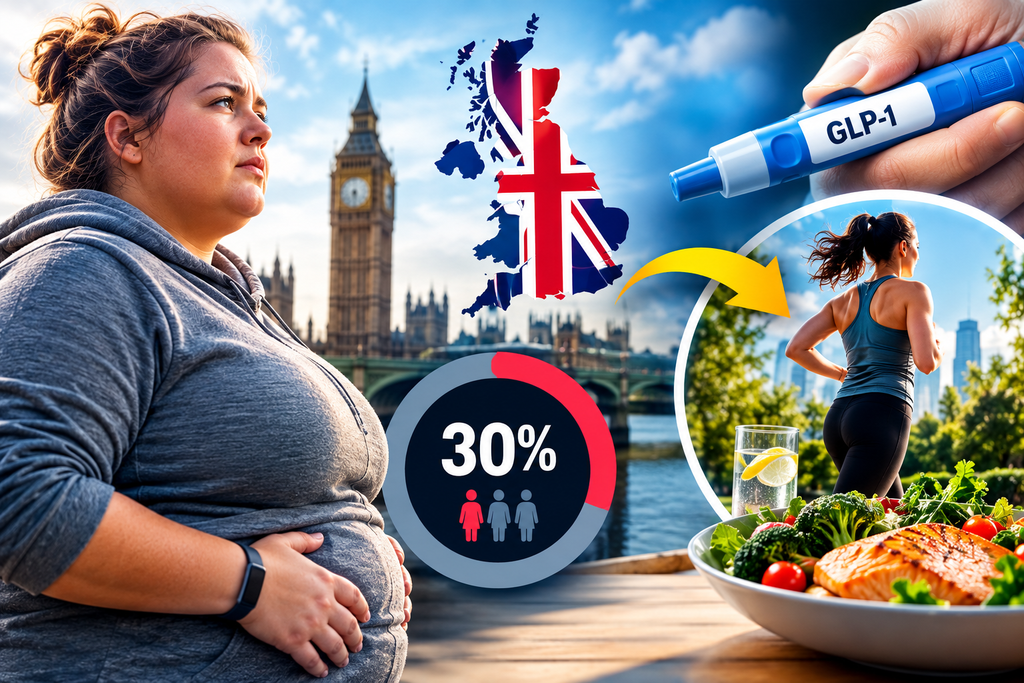
Obesity remains one of the United Kingdom’s most persistent public health challenges. In England, the 2024 Health Survey for England found that 30% of adults aged 16 and over were living with obesity, defined as a BMI of 30 kg/m² or higher. When overweight is included, 66% of adults were above a healthy weight—equivalent to roughly 14.3 million adults living with obesity in England.
The scale of the problem is striking. Adult obesity prevalence in England has approximately doubled since 1993, when it was around 15%. Despite successive governments introducing numerous national obesity strategies over the past three decades, population-level obesity has continued to rise.
The Four-Nation Picture
Obesity affects all four nations of the UK, although prevalence varies:
- England: 30% of adults were living with obesity and 66% were overweight or obese in 2024.
- Scotland: Around 31% of adults were living with obesity in 2024, with prevalence higher among women than men. Mean adult BMI was approximately 28.1 kg/m².
- Wales: Adult obesity prevalence remains in the high-20% range, with roughly six in ten adults overweight or obese.
- Northern Ireland: Obesity affects more than one-quarter of adults, while around two-thirds are overweight or obese.
Differences in survey methods—including self-reported versus measured height and weight—mean that direct comparisons between nations should be interpreted cautiously.
Children Are Entering the Problem Earlier
The obesity challenge is not limited to adults.
Among children aged 2–15 in England, approximately 15% were living with obesity in 2024, while around 26% were overweight or obese. Prevalence generally increases with age.
By the end of primary school, the scale becomes particularly concerning. National Child Measurement Programme data indicate that around one in five children in Year 6 is living with obesity.
This makes childhood obesity one of the most important indicators of the UK’s future health burden.
A Stark Inequality Problem
UK obesity rates are not evenly distributed across society. Deprivation, geography, age and ethnicity are strongly associated with differences in obesity prevalence.
People living in the most deprived communities can experience obesity rates more than twice as high as those in the least deprived areas. The burden is also generally greater across parts of the North and Midlands than in some areas of London and southern England.
Age matters too. Obesity prevalence is particularly high among middle-aged and older adults, while increases among younger adults have raised concerns about the long-term trajectory of the epidemic.
The result is more than a national average: where someone lives and their socioeconomic circumstances can substantially influence their risk of obesity.
Why Are UK Obesity Rates So High?
There is no single explanation.
The modern food environment provides constant access to inexpensive, highly palatable and energy-dense foods. At the same time, many people face barriers to physical activity, including sedentary jobs, car-dependent environments and limited access to convenient recreational spaces.
These environmental pressures interact with income, stress, sleep, genetics, medications, early-life factors and individual biology.
Obesity therefore cannot simply be reduced to a question of personal choice.
The Health and Economic Cost
Obesity increases the risk of numerous chronic conditions, including type 2 diabetes, cardiovascular disease, certain cancers, musculoskeletal disorders and sleep-related conditions. It can also affect mobility, mental wellbeing and overall quality of life.
The financial consequences are substantial. Obesity-related healthcare costs to the NHS in England are estimated at billions of pounds each year, while wider costs—including reduced productivity, sickness absence and long-term disability—are considerably larger.
Can New Weight-Loss Treatments Change the Picture?
The arrival of GLP-1 receptor agonists and other anti-obesity medicines has changed the treatment landscape. These drugs can provide clinically meaningful weight loss for eligible patients when used alongside appropriate lifestyle and medical care.
However, medication alone is unlikely to reverse a population-wide obesity epidemic. Treatment must be combined with prevention and broader action addressing food environments, physical activity, early-life health, urban design and socioeconomic inequality.
The UK Obesity Outlook
The central challenge is no longer simply recognising that obesity is increasing. It is understanding why progress has been so difficult despite decades of policy intervention.
The UK’s experience demonstrates that obesity is a long-term, multifactorial public health problem rather than a short-term lifestyle trend.
With around one in three adults in England now living with obesity, and childhood obesity remaining high, reversing the trajectory will require sustained action across healthcare, government, communities, schools and the wider food environment.
The UK obesity crisis is not just about weight—it is about the future health, productivity and wellbeing of an entire population.