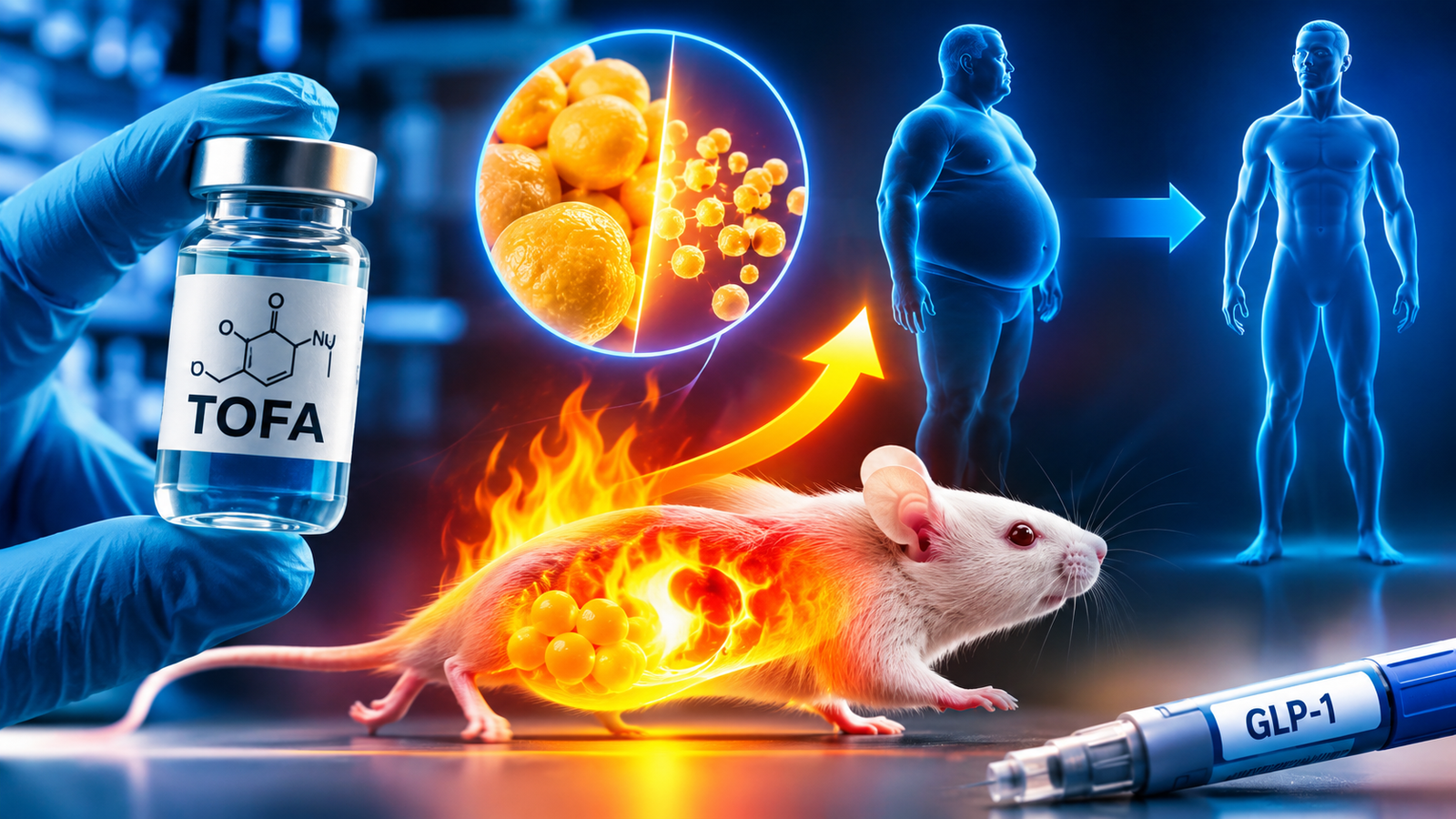
An experimental compound called TOFA could point toward a different strategy for treating obesity: increasing the body’s energy expenditure rather than simply reducing appetite.
Researchers at the University of California, Berkeley found that 5-tetradecyloxy-2-furoic acid (TOFA) helped obese male mice lose substantial body fat while maintaining lean mass. The findings were published in Science Advances on August 21, 2026.
What Makes TOFA Different?
Most modern obesity medicines work, at least partly, by helping people eat less. GLP-1-based medicines such as semaglutide and tirzepatide can reduce appetite and food intake.
TOFA takes a different approach.
In the mouse experiments, food intake and physical activity did not change, yet whole-body energy expenditure increased by as much as 18%. After four weeks, obese male mice experienced an average weight reduction of about 18%, with most of the lost weight coming from fat rather than lean tissue.
That distinction is important because researchers are increasingly interested in how obesity treatments can reduce fat mass while preserving muscle and other lean tissue.
How Does TOFA Work?
TOFA appears to act on multiple aspects of lipid metabolism.
Researchers found evidence that it:
- Inhibits acetyl-CoA carboxylases (ACC1/2) involved in lipid production
- Activates PPARα/δ-related energy and fat-burning programs
- Increases energy expenditure
- Reduces lipid accumulation
The combination appears to change how the body handles incoming energy rather than simply reducing the amount of food consumed. However, researchers say the complete mechanism behind the increased energy expenditure is still not fully understood.
More Than Weight Loss
The effects were not limited to body weight. In obese mice, TOFA also improved insulin sensitivity and glucose control, reduced triglycerides and improved features associated with fatty liver disease.
Researchers also tested TOFA alongside semaglutide and tirzepatide. The combinations produced greater metabolic and weight-loss effects than the individual treatments in the experiments, suggesting that increasing energy expenditure could potentially complement appetite-reducing therapies.
Could TOFA Become a Human Weight-Loss Drug?
Not yet.
This is an animal study, and TOFA has not been tested in humans for obesity treatment. Its effective human dose, safety profile and long-term effects remain unknown. The researchers say additional toxicology and efficacy studies in rats and larger animals are needed before human trials can begin.
There is also an important limitation: the live-animal experiments involved male mice, so it remains uncertain whether the same effects would occur in females.
The researchers have co-founded ReRx Therapeutics, which is developing TOFA-related intellectual property toward potential therapeutic applications.
The Bigger Obesity-Drug Picture
TOFA highlights an emerging question in obesity research:
What if future weight-loss drugs could attack both sides of the energy equation?
Instead of relying only on “eat less,” combination therapies could potentially pair appetite reduction with increased energy expenditure.
For now, however, TOFA remains a promising preclinical compound—not an approved weight-loss medicine.
Bottom Line
TOFA’s results in obese mice are intriguing because the compound increased energy expenditure and reduced fat mass without reducing food intake or causing significant lean-mass loss. But translating a striking mouse result into a safe and effective human obesity treatment requires years of additional research.
Disclaimer: TOFA is experimental and has not been established as a treatment for obesity in humans. Do not use or purchase TOFA for weight loss. This article is for educational purposes and does not constitute medical advice.
Reference: Science Advances